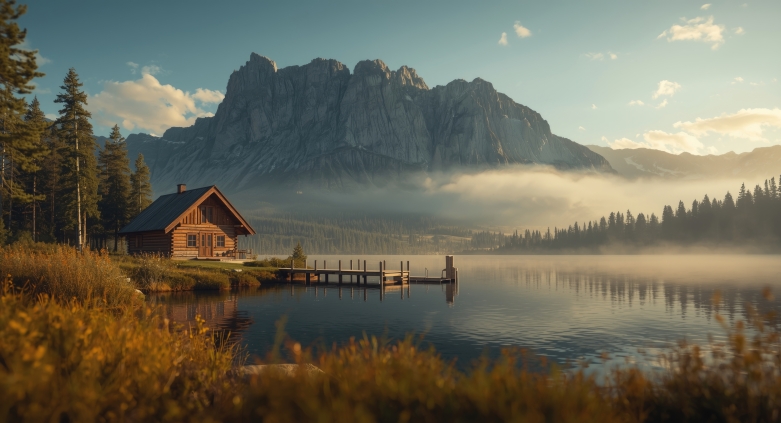
Mountain cabin by the lake

At the beginning of the current school year one of the professors in the Business division at Southwestern Adventist University announced they would be retiring at the end of the school year. Our search process began by identifying what our "ideal" candidate will look like - the degree(s) they have completed, the skills they posses, the experience they have gained, their relationship to the Adventist church, and the classes they are capable of teaching. Over the past several months we have received many applications for the position but none of them have met our ideal qualifications. I have learned over my 12 years teaching in higher education that this phenomenon is not uncommon - most job posting for professor positions have an "ideal" candidate description and a "will consider" candidate description. The ideal is what your "perfect" candidate will look like and the "will consider" is what you will settle for.

 
In decision theory (a subset of data analytics) this is the distinction between the optimal and satisficing outcomes - what is the best you can hope for vs. what will you be satisfied with. Satisficing solutions do NOT attempt to maximize objectives, instead they seek to exceed MINIMUM standards. This process is accomplished by establishing constraints that either must be met or can not be exceeded. Solutions are then evaluated based upon living within the boundaries of those constraints. Most models for decision theory do not solve for optimal, they only solve for satisficing. In our situation many of the candidates did not meet the constraints for minimum qualifications but several did leading us to interview those qualifying candidates and attempt to identify the best satisficing solution.
 
Interestingly most job seekers do not seek optimal employment but instead seek satisficing jobs (we see this documented in the roughly 80% of employees who are dissatisfied or unsatisfied with their work.) While they may WANT an optimal job they often settle for something far less. They feel stuck and unable to change their circumstances. Henry David Thoreau summed it up nicely in Civil Disobedience and other Essays when he said "the mass of men lead lives of quiet desperation." We spend our time trying to "find" happiness rather than simply being happy.
 
For many years when our children were young we spent our vacations rushing from one place to another where the destination was the ultimate goal. Regularly we would drive over 800 miles in a day (one time it was over 1,000.) In 2005 we flipped the script and planned a vacation to Southern California (our son wanted to go to Legoland in Carlsbad, California). On that trip we intentionally limited daily driving to under 300 miles and only exceeded that on two occasions - once leaving Yellowstone National Park and the other the last day of our trip driving from Colorado Springs, Colorado to Bismarck, North Dakota. We stopped a Mt. Rushmore, Devils Tower, Yellowstone, Grand Tetons, Great Salt Lake, Kings Canyon/Sequoia, Sacramento Zoo, Legoland, Sea World, San Diego Zoo/Wild Animal Park, Grand Canyon, Painted Desert, 4 Corners National Monument, Mesa Verde, and Pikes Peak (Lisa and the kids also went to Whit's End at Focus on the Family in Colorado Springs while I was in meetings!) For that trip it was all about the journey and not the destination.
 
I have often wondered if my relationship with God is focused too much on the destination and not enough on the journey. Instead of seeking for an optimal experience I settle for satisficing. In John 10:10 Jesus tells us that He came so that we might "have life, and have it more abundantly," In John 5:24 Jesus also states that if we hear His voice and believe Him we have "passed out of death and into life." This is present tense not future, God wants us to experience abundant life now not just sometime in the future! He wants us to experience the optimal life not just a satisficing one!
 
***Lisa and I often see pictures like this one and say "I could live there!" This photo is AI generated and not one I took, although it does depict part of what an optimal life might look like for me.***
Fresh Articles

  • [God] Loves You, and There is Nothing You Can Do About It

    The past two weeks I have attempted to begin the Sabbath by pausing to contemplate some aspect of my week reviewing how God has spoken to me in some quiet way as I start the day He has set aside to fellowship with us. This week was a busy week and as a result I had another appointment that left me rushing to get home before sunset that left me falling over the edge into Sabbath instead of ushering it in quietly. I have contemplated often how Lisa's and my dog Pogo illustrates my rushed relationship with God. I may explore that more in depth in another post at another time, but today is Valentines day so I want to explore that concept a little today.

  • Don't Just Do Something, Sit There!

    Last week I mentioned our dog Pogo and how he illustrates my often chaotic relationship with God. He is a pure bred (he was never registered but we have his pedigree papers) Australian Shepherd who came to live with us about 5 1/2 years ago when he was 1 year old. We adopted him from a family that had gotten him as a puppy for their (young adult) son. When their son joined the military they found themselves caring for a dog that unfortunately mom was allergic to - so the dog had to go! When we visited to assess the compatibility fit between him and our home we discovered that he was a very high strung, high octane animal, he had 3 speeds - off, full throttle, and warp speed. He could go from full off to bouncing off the walls in a half second.

  • Pruning for Growth

    Shortly after we moved into our house here in Texas Lisa found two concord grape vines on sale at our local Home Depot. We planted those and the next year bought four more, adding them to our "vinyard " in the back yard. Unfortunately neither of us knew anything about growing grapes! The first year they all took off sending out canes down the supporting wires we had strung along our back fence. The second year they produced a few grapes (almost enough for a single batch of jelly). The next year we got a lot of buds but not a single one matured into an edible grape. What we didn't know then is that in order for grape vines to produce grapes they need to be pruned - every year, all but 5 or 6 buds on each cane. Grape vines produce a lot of growth. First year growth is called a cane, older growth is called a cordon. It is only canes that produce grapes - too many cordons sap the energy from the vine, robbing it of its ability to produce grapes! If you want to produce grapes you have to get rid of the old cordons every year! Relying on what grew last year won't produce any fruit!

  • They're Not Your Ducks

    This week has been a wild and crazy week with lots of twists and turns leading to some thought provoking moments. At one point while talking with a friend about how both Lisa and I were feeling God's leading regarding certain aspects of our lives they asked a very direct and probing question, "If things don't work out with the plan you are currently pursuing are you going to continue down this path anyway?" My answer was rather sobering - "I'm not sure I have that much faith!" That answer prompted some serious contemplation over the next 24 hours. Thinking of the father whose son was possessed by a demon and the disciples could not cast it out. When the father asked Jesus to cast it out Jesus' response was "If you believe, all things are possible." The fathers response was mine that day, "I believe, help my unbelief." (See Matthew 9:14-25 for the story.) My problem is I want to have all my ducks in a row. I don't just want them in a row, I want to know where they are going and how they are going to get there! That is not faith, that is certainty and I struggle balancing faith with certainty.

  • I've Got Your Back

    A number of years ago while I was working at Home Depot I was being trained to manage outside deliveries. Each day we would check the order log to see what deliveries were scheduled for the next day, pull all the product, and organize it so when the delivery driver showed up the next day it could be loaded on the truck. One of the most demanding responsibilities was operating the forklift to load the trucks. Since most orders were small and the delivery drivers would make several stops on each run we would have to load the orders in a way that would align them with the delivery schedule ensuring that drivers had access to the correct products at each delivery stop. Sometimes we had to place pallets touching each other end-to-end in order for it all to fit on the length of the truck, and we ALWAYS had to fit them precisely side-to-side so the pallets wouldn't hang over the side of the truck. Jeff worked with me for several weeks teaching me how to load precisely and operate the forklift safely. Many mornings he would stand beside the truck observing my efforts and giving me pointers on how to load more efficiently. I remember well the morning I came into work and Jeff informed me that I was on my own that day. I was a little nervous but Jeff made a statement that really struck home - "I've got your back!" He said it mater-of-factly - "I've got you covered, you can do this, but I'm right around the corner if you need my help." He was sure I could handle it but just wanted me to know that if I got into a bind he was there to bail me out. Later, when I was training other members of the outside delivery team I would use those same words. "I've got your back!" as I encouraged them as they learned.

  • One More Step

    When I was younger my brothers and I would often camp beside the pond at the top of Tumbledown Mountain in Weld, Maine (unfortunately camping is now prohibited on the mountain.) Most of the time we would be the only campers on the mountain providing a peaceful solitude away from the busyness of life. We would start at the drive-in base camp located on a long dirt road off the main highway leading into Weld and hike the nearly 3 miles along the Parker Ridge trail to the top. From this bare summit we could look down on Tumbledown pond or we could look to the south and east toward Webb lake and Mt. Blue. One of the defining features of this hike was the climb through the woods to a steep ascent that lead over three succeeding rock ledges before finally ascending Parker Ridge. As you came out of the woods all you could see was the crest of the first ledge. For a first time hiker it appears you are about to reach the summit, only to be disappointed when you finally get there and discover there is another ridge. That experience was repeated two more times as you crested ledges two and three before finally reaching the (almost) summit (if you continue on the loop trail that goes around the lake you will ascend to a higher summit before descending back down through the "chimney" and "fat man's misery" - it is far better to come UP that trail rather than try to go down!)